
I’ve been in the industry for 21 years. Thirteen of those were spent in e-commerce and supply chain — six at Amazon, three and a half at Alibaba, three and a half at ByteDance. Every time I joined a new place, there was the same arc: excitement in the first year, then a slow grinding into numbness. Working until 9 or 10pm became the baseline. Slack was always open, even on weekends. My calendar was wall-to-wall from 9am to 6pm, so actual thinking had to happen before or after that window. The team’s backlog could balloon to a hundred items, and somehow a third of them were SEV1-equivalent in the eyes of the business partners who filed them, because every single one was “blocking growth” for someone. I remember sitting in a requirements alignment meeting, trying to explain to an increasingly agitated PM why we couldn’t ship four major features in the same sprint, and a thought surfaced that I couldn’t push back down: what am I actually doing here?
I’ve been out for about four months now. No Slack. No on-call rotation. No performance review cycle breathing down my neck. In that space I’ve been turning over the same questions, and I want to share what I’ve found — for anyone sitting in a similar fog.
This is my first piece of writing since leaving. I want to start at the root: goals. Not the OKR kind. The actual kind.
We all understand, at some level, why we work. Pay the mortgage. Keep the health insurance. Maybe get to the next level — L6, L7, staff engineer, director — and give your family a better shot. That logic is airtight, and I don’t want to pretend it isn’t. But somewhere inside it is a flaw, and a lot of people feel it without being able to name it. Why, if you’re doing everything right, does it still feel hollow?
Busy Isn’t a Direction
After months of actual stillness, the first I’d had in over two decades, I finally understood something that had been obvious all along: the exhaustion I felt, and that I watched accumulate in the engineers and managers I worked with, was never really about workload. It was about direction. In the years I spent managing large teams at Amazon and ByteDance, I watched good people — smart, committed, technically strong — get gradually ground down by a schedule they hadn’t chosen, toward outcomes they couldn’t fully endorse. Sprints would end and new ones would begin. OKRs would roll over. Everyone was visibly, measurably busy, and almost nobody could tell you, in an honest moment, what they were actually building toward.
The real issue was simpler and more uncomfortable than overwork: almost nothing you spent your day doing was something you had chosen. It was assigned, inherited, escalated to you, or filed in your queue by someone who needed it done.
I was, for years, essentially a sophisticated routing layer in a distributed system I didn’t design. Requests came in from product and leadership, I parsed and prioritized them, dispatched work downstream, reviewed outputs, handled the inevitable incidents. I was good at it. I got promoted. And then I read Paul Millerd’s “The Pathless Path” and he put a name to what I’d been operating inside: the default path. It’s the industrialized script that says the formula is school, job, climb, optimize — and that if you follow it faithfully, fulfillment will eventually materialize somewhere down the road. During a decade of economic expansion, this generates enough positive feedback that you don’t notice the seams. You work hard, things improve, you get rewarded. The loop closes. But the loop has quietly broken for a lot of people, and the system didn’t send an alert.
What happens instead is that the discomfort is small and persistent, like a pebble in your shoe you keep forgetting to remove. You push through on willpower. You tell yourself it’s a crunch period and things will calm down after the launch. They don’t. You adapt, and the new normal quietly becomes the old crunch. I saw this in people who reported to me — engineers burning out not from a single catastrophic overload but from years of grinding other-directedness, every hard thing on their plate assigned by someone else’s roadmap. They weren’t lazy. They weren’t weak. They had just been slowly worn down by a system that never once asked if this was what they wanted.
The deeper trap is that you get good at mistaking the external script for your own goals. You convince yourself that the L7 promotion is what you actually want, that surviving the org restructuring will finally give you breathing room, that shipping the platform migration will feel like an arrival. There’s a term for this in psychology: the arrival fallacy. Reach the milestone and what you feel is usually just emptiness, because the milestone was never really yours to begin with. I’ve watched this play out more than once: someone grinds through six months of brutal delivery, gets promoted, posts about it on LinkedIn, then shows up Monday morning to the same standup, the same Slack threads, the same on-call rotation, the same calendar — with nothing behind their eyes. The arrival didn’t arrive.

Where Your Days Actually Live
One thing I hadn’t expected about leaving was how destabilizing the lack of structure would feel. I thought I was tired. I was — but I’d also forgotten how to navigate without external direction. Those first weeks were strange. I had time but kept reaching for tasks that weren’t there. And in that discomfort I started to understand something about goals that rarely gets said: they aren’t just motivational fuel. They’re attention management. When you have a direction that genuinely belongs to you, your brain does the filtering automatically — this Slack message matters, that one doesn’t; this article is signal, that one is noise. Strip that away and you get entropy. You scroll without absorbing anything. You read the same paragraph three times. You lie awake with a mind that won’t shut down, not because you’re worried about anything specific, but because the energy has nowhere to go. There’s a line I keep coming back to from a Hacker News thread: “If you don’t have a plan for yourself, you’ll end up being part of someone else’s.”
So one afternoon I grabbed a pen and a blank sheet of paper and started sketching a framework I’d been turning over in my head. Two axes: difficulty on the horizontal, autonomy on the vertical — how much you actually chose this. I started placing things on it. Every kind of work I’d done across 21 years. Where had my days actually been living?
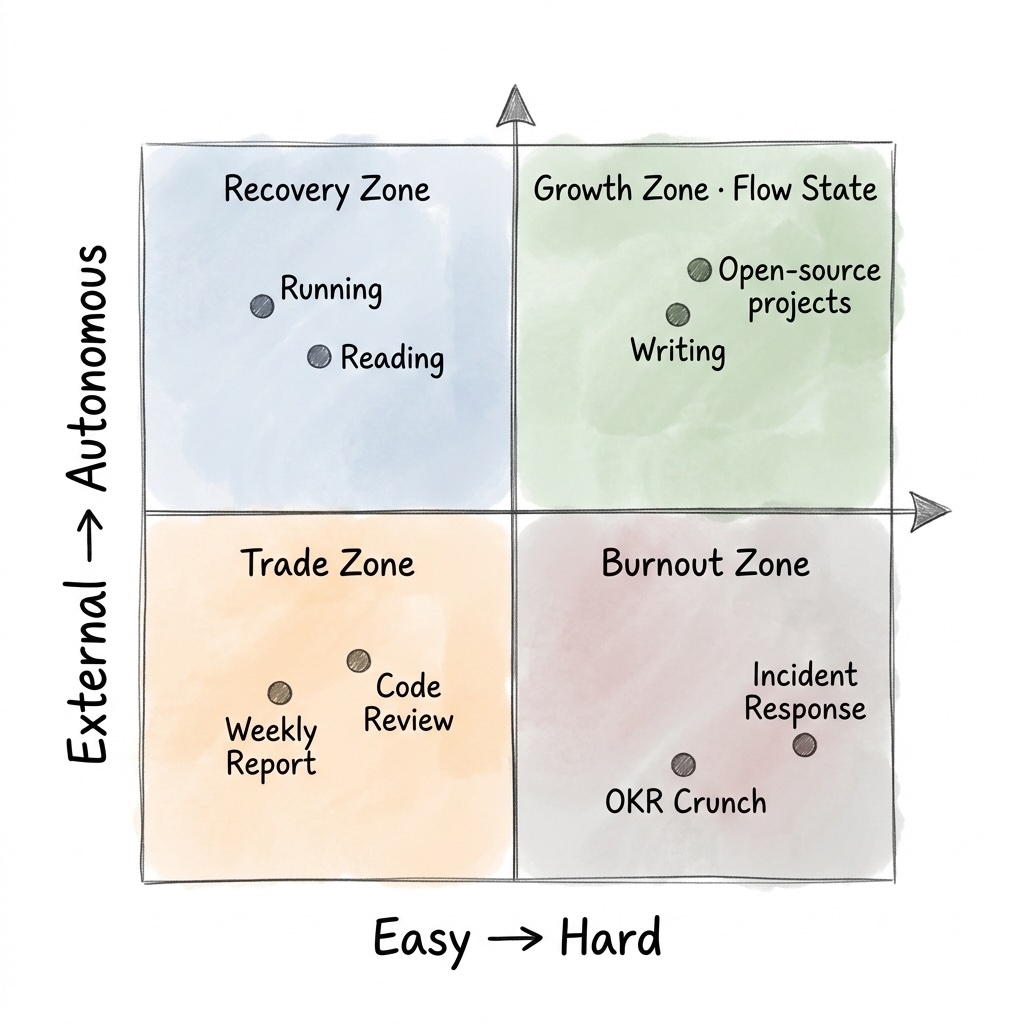
Work you chose and work you were handed feel completely different, and the difference isn’t really about effort or interest. It’s about whether you’re present or just functional. One question I kept coming back to: if this thing disappeared from my plate tomorrow, would I feel relieved or would I feel a loss? The answer is usually immediate.
Looking at what filled the upper-left quadrant — high difficulty, low autonomy. Responding to SEV1 pages at 2am. Pulling all-nighters for a quarterly OKR I privately thought was poorly conceived from the start. Executing roadmap decisions I’d argued against in the planning meeting and lost. When I managed teams at Bytedance, most of the engineers I worked with spent most of their time here — not because anyone was malicious, but because urgent assigned work expands to fill whatever space exists. The burnout risk is obvious. What’s less visible is what happens to your skills: stay here long enough and they calcify around one system’s specific quirks, and you slowly become someone who can only run that one thing.
The adjacent quadrant — lower difficulty, still assigned — is more benign. Status updates, sprint planning ceremonies, standard code reviews. The overhead of participating in a functioning org. Do it, move on, don’t let it consume more bandwidth than it deserves. Just don’t mistake it for the substance of your work.
Then there’s the lower-right: things you chose that aren’t particularly demanding. A book with nothing to do with work. A run. Tinkering with some personal project on a Sunday morning that will never ship anywhere. Aristotle called this “noble leisure” — which sounds pretentious, but he was onto something. Low-stakes exploration is where the subconscious does its best work, making connections the grinding conscious mind misses. I didn’t spend nearly enough time here during those years.
The quadrant that hit me hardest was the upper-right: high difficulty, self-directed. Work that’s genuinely hard and genuinely yours. Learning something at the edge of your capability because you want to. Building something that might fail because the problem interests you. Writing something honest in public. This is where growth actually happens, the kind you carry with you. Looking back at those thirteen years, this quadrant was nearly blank. And looking at the people I managed: all the hard stuff in their days was assigned. The hard stuff they’d chosen for themselves — nobody had claimed that space.
The full picture was uncomfortable enough to be useful. The “high difficulty, assigned” corner had consumed something like 80 to 90 percent of my waking hours across years, not quarters. The time that actually belonged to me was a rounding error. That’s not busy. That’s captured.
Taking Back the Target
I’m not going to tell you the answer is to quit and start a blog. The pathless path — deliberately stepping off the default track — was right for me, and it isn’t right for everyone. Pretending otherwise would be condescending. What I actually care about is more specific: whatever path you’re on, you need to be fighting to keep some portion of it genuinely yours.
So let me share what I’d actually tell someone, having managed teams across three companies for a combined decade-plus and watched, up close, what happens to people over five-year arcs rather than quarter by quarter.
Get specific about what you don’t want. Not abstractly — I watched it happen to people who were genuinely talented. They fought fires, delivered, stayed late. After five or six years, their technical breadth had narrowed: they knew the internal systems of the current product deeply but had lost fluency with anything outside it. Meetings had ground them down. They’d stopped having opinions about their own growth. When they eventually left, the skills they could take with them were thinner than they expected. I was the one assigning them work during that period, which is why the image is vivid. Write down the version of yourself you don’t want to be in five years — that specificity is more useful than any positive aspiration. Then ask: if my manager’s priorities evaporated tomorrow, would I still be doing this? If yes, there might be something real there. If no, it’s just a task. When I was still working, I started doing a quiet translation of my OKRs: within this quarter’s goals, which skills am I actually building? Which are pure execution — value delivered, nothing deposited in my own account? The execution items I’d do well enough and nothing more, redirecting whatever margin remained toward the self-directed quadrant.
Good work also requires actual recovery, and this took me embarrassingly long to accept. Not “I’ll relax after the launch” — real breathing room, built in. I’ve had more useful ideas on a 45-minute walk than in a full day of blocked desk time. So I started setting a deliberately low threshold: 30 minutes a day on something I chose, something I was learning or building for its own sake. An hour or two a week to get something small enough to show. The early outputs are mediocre, and that’s fine. The signal to pay attention to is when something that used to take two hours takes thirty minutes. That’s where it starts to compound. In a world where AI is aggressively compressing the value of narrow specialization, the things that look like useless side interests today are more likely than people think to become the actual moat.
And figure out your number. Working for money isn’t a moral failing — it’s how most of us keep the lights on, and there’s nothing wrong with optimizing for it in a given season. But there’s a difference between “I’m trading time for resources during this phase” and “I’ve conflated compensation growth with personal growth and can no longer tell them apart.” The treadmill is hardest to get off when the speed keeps increasing, because stepping off feels like falling. Figure out what enough means to you, concretely, not hypothetically, and notice whether your current trajectory is moving toward it or just perpetually deferring it.
Try this: take the ten things that have consumed the most of your time in the last month. For each one, ask — if this disappeared tomorrow, would I feel relieved or would I feel a loss? Find the ones keeping you in that upper-left corner. Then this weekend, not eventually, pick one thing from the quadrant that belongs to you and spend 30 minutes on it. The point isn’t the 30 minutes. The point is choosing.
You’ve probably been inside someone else’s script for longer than you realize. You can start writing your own today, or keep waiting for a better moment that isn’t coming.